
Career Change Resume: How to Reframe Your Experience When You're Switching Fields
Switching fields? How to write a career change resume that leads with transferable skills, reframes your experience in the new field's language, and explains the pivot.
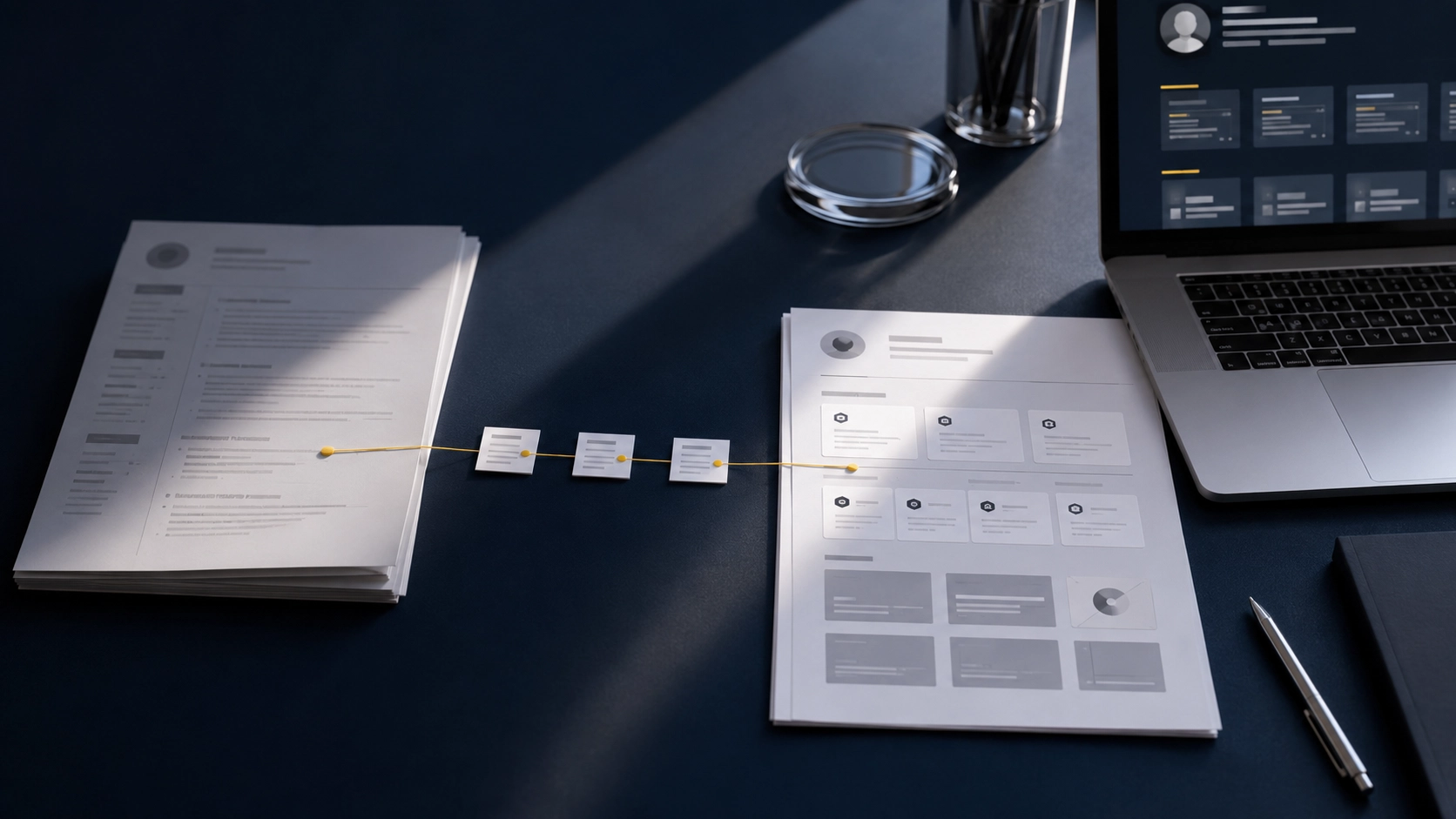
On paper, a career change can look like a mismatch. You know your skills transfer; the resume just doesn't show it. A standard resume leads with the titles you're trying to move past, and a recruiter scanning for someone who's already done the job often moves on before they reach the part where you'd be great at it. The problem usually isn't your ability — it's that the format is built for linear careers, and yours isn't one.
Here's how to reframe a career change resume so your relevant experience comes first, plus where the resume runs out of room and what to do about it.
A career change resume at a glance
- Open with a positioning summary that names where you're headed and the throughline.
- Use a hybrid (skills-forward) format, not a pure chronology and not a pure functional one.
- Translate your accomplishments into the target field's language.
- Foreground transferable skills with specific, proof-backed results.
- Tailor hard to the exact role.
- Address the "why" briefly — a line, not a paragraph.
Why a standard resume works against career changers
A reverse-chronological resume is built to show one thing: steady progress in a single lane. A career changer doesn't have that, so the format works against you — it leads with your most recent (and least relevant) title and frames a deliberate pivot as a question mark. It compounds in screening, too: applicant tracking systems rank applications by how closely they match the role's keywords, and a changer's resume often lacks the target field's terms, so it may be harder to surface in first-pass reviews even when the transferable parts are strong. None of this means you're unqualified — it means the default format hides the case for you instead of making it.
Start with a positioning summary
The single highest-leverage move on a career change resume is a short summary at the very top — three or four lines that tell the reader how to interpret everything below. Name who you are, the field you're moving into, and the throughline that connects them.
Without it, a recruiter has to reverse-engineer your story from a list of mismatched jobs, and most won't. With it, you set the frame before they reach your history: "Operations manager moving into product management, bringing six years of turning cross-team chaos into shipped results." That one line turns a confusing career into a coherent one.
Lead with skills, not job titles
A pure chronology forces your old titles to the front. A skills-forward layout lets you lead with the capabilities the new role actually needs.
The format to use is a hybrid, not a pure functional resume. A pure functional resume — skills with no clear work history — tends to raise flags with recruiters and some ATS, which read the missing chronology as hiding something. A hybrid keeps the credibility of a real timeline while changing the emphasis: a strong summary and a "core skills" or "relevant experience" section up top, followed by your normal reverse-chronological history underneath. You're not concealing your past; you're just deciding what a recruiter sees first.
A simple hybrid structure looks like this:
- Summary — who you are now and where you're headed.
- Relevant skills or selected wins — three to five proof-backed bullets tied to the target role.
- Work history — normal reverse-chronological experience, with bullets translated toward the new field.
- Education, certifications, projects, or training — only what supports the pivot.
Translate your experience into the new field's language
The same accomplishment can read as irrelevant or perfect depending on the words you use. Career changers win or lose on this translation.
Reframe each past win in terms the target field cares about, mirroring the vocabulary of the job posting. A teacher moving into corporate training doesn't say "managed a classroom of 30" — they say "facilitated learning and measured outcomes for groups of 30+." A bartender moving into sales doesn't list drinks; they describe "upselling, regulars retention, and handling high-volume customer pressure." A customer success manager moving into product marketing doesn't just say "managed enterprise accounts"; they say "translated customer pain into positioning, enablement, and product feedback for go-to-market teams." The work is the same. The framing is what makes a hiring manager see a fit instead of a stretch.
How do you explain a career change on a resume?
Briefly. A recruiter wants to know the change is intentional, not a sign of instability — and a single line in your summary usually does it: a short, forward-looking statement of why you're moving and what you bring. Resist the urge to justify the whole journey on the page. There isn't room, and over-explaining reads as defensive.
This is also where the resume hits its real limit. The full case for a pivot — why now, how your skills transfer, what you've done to prepare, the genuine motivation behind it — is exactly the context a one-page document has to cut. You can gesture at it in a line. You can't actually make it.
What is an interactive career profile?
An interactive career profile is a shareable link that lets a recruiter ask questions about your background and explore the context behind your resume, rather than just read a static document. It's the gap we built Worksona around.
For a career changer, that gap is the whole problem. The case for your pivot — the why, the transferable skills, the preparation — is precisely what a resume strips out and what a recruiter is most unsure about. An interactive profile gives you room to make that case in full, and it lets a recruiter ask the question they're actually thinking — "can someone from that background really do this?" — and get an answer grounded in the context you've provided, instead of leaving them to judge you only by a last title that doesn't match. You can send it right alongside your resume, so the document handles the basics and the profile carries the story.
It's the difference between a resume that makes your pivot look like a question mark and a profile that answers the question.
Frequently asked questions
How do you write a resume when changing careers? Lead with a summary that frames your pivot and the throughline, use a hybrid (skills-forward) format so relevant abilities sit above your old titles, translate past accomplishments into the target field's language, foreground transferable skills with specific results, and tailor hard to the role. Keep the explanation of why you're changing to a brief line.
Should a career changer use a functional resume? A pure functional resume usually isn't ideal — recruiters and some ATS treat a missing work history as a red flag. A hybrid is safer: a strong skills and summary section up top for emphasis, followed by a normal reverse-chronological history for credibility.
How do you show transferable skills on a resume? Identify the skills the new role needs that you already have, put them in a "core skills" or "relevant experience" section near the top, and back each one with a specific, quantified result from your past work — described in the new field's language rather than your old one.
Should I include unrelated experience on a career change resume? Yes, but reframe it. Keep the work history for credibility and chronology, then rewrite the bullets around the transferable skills, outcomes, and responsibilities that connect to the target role. Cut details that only matter in your old field.
How do you explain a career change on a resume? In a single forward-looking line in your summary: where you're headed and what you bring, framed as a deliberate move rather than a justification. The resume has no room for the full story, so keep it short and let a richer format carry the rest if the role needs it.
Is an interactive career profile the same as a personal website? No. A personal website is usually a static destination someone has to browse. An interactive career profile is built around questions — a recruiter can ask about your experience, projects, strengths, or fit for a role and get answers from the context you've provided. We compare the two head-to-head in personal website vs. interactive career profile.
The bottom line
A career change isn't a weakness on a resume — it's a context problem the resume format is badly suited to solve. Reframe it well: lead with a positioning summary, put transferable skills above old titles, translate your wins into the target field's language, and tailor hard to the role. Those moves get your relevant experience read first instead of last.
But know where the page runs out. The full case for your pivot — the why, the preparation, the proof that your skills carry over — doesn't fit in one document, and it's exactly what a skeptical recruiter wants to understand.
If you're changing fields, the hardest part is getting someone to see past your last title — and that's exactly what Worksona was built for. Create your profile and give recruiters the context behind your pivot: the transferable skills, the proof, and the why, in a form they can actually explore and ask about.


Career insights, straight to your inbox
Occasional, no-spam notes on standing out, the job search, and what we’re building at Worksona.
No spam. Unsubscribe anytime.